Blown Asphalt Production Process

Oxidized Bitumen Production Process: The producing operation of oxidized bitumen mainly includes tank loading different steps, bitumen blowing, condenser external gasses and packing.
So, in the beginning, the loose bitumen shipped to the plant by tanker is transferred to the raw material store tanker.

Production Process of Blown Asphalt or Oxidized Bitumen

Bitumen is a hydrocarbon product which is received as the distillation bottom product of an oil refining process and has a high boiling point and viscosity and is soluble in trichloroethylene.

Also, the soluble binder product separated from natural asphalts by extraction is bitumen. To improve the properties of bitumen it can be oxidated to be suitable for intended applications. This oxidation can be carried out by leading air to the bitumen which is oxidated by the effect of the oxygen diffused into the oil phase from the air.

In modern preparation methods of oxidated (blown or semi-blown), asphalt qualities the air needed for the oxidation and the bitumen oil is brought into contact in a large volume reactor (so-called bubble column technique).

The drawbacks of the method are the safety risks because of the large oil and gas volume, the high oxygen content of the rest gas, a bad adjustability of the reaction and the reduced quality properties of the product because of the long retention time.

The contact between the bitumen and the oxygen has been improved by using a turbine mixer in the oxidation of the asphalt. This turbine mixer comprises a mixer foreseen with an impeller that consists of a cogged face plate. The use of such a mixer does not, however, essentially improve the transfer of the material.

It is also mentioned as prior art which is concerned with a method of oxidation of asphalt by air in a large volume reactor. The aim of this invention is to reduce the retention time of the oxidation reaction and thus avoid reducing the quality properties. The cold properties are even improved.

The aim is e.g. to achieve a bitumen product suitable to be used as road coating expressly in cold conditions, as in the Northern countries, which for instance means that no fractures are allowed to be formed into the coating.

The method of the invention is mainly characterized in that the oxidation is carried out by leading a supply stream of bitumen or the like and an air stream or another pressurized gaseous oxidant to a reactor which is a so-called rotating apparatus and in which reactor the contact between the air or other gaseous oxidant and the bitumen or the like is improved by generating turbulence by mixing devices of rotor-stator type that generate shear forces to achieve a good mixing.

The advantageous embodiments of the invention have the characteristics of the sub-claims.

The contact between the air and the bitumen is carried out in the invention by using high turbulence. The reactor used in the invention generates turbulence by using mixing devices of rotor-stator type that generate the shear forces: the bitumen and the air are forced through the reactor in such a way that strong shear forces and much mixing are directed to those with a good dispersion of the air as a result that is very advantageous for the contact.

In the preparation method of the invention, the reactor used to improve the contact of the air-bitumen mixture, the so-called rotating apparatus, is a so-called power homogenizer, which is a mixing device of the type wherein the mixing is achieved ¦ by one or more rotor-stator pairs, alone or in series.

Applications of Bitumen 60/70, Blown Asphalt Production Process,

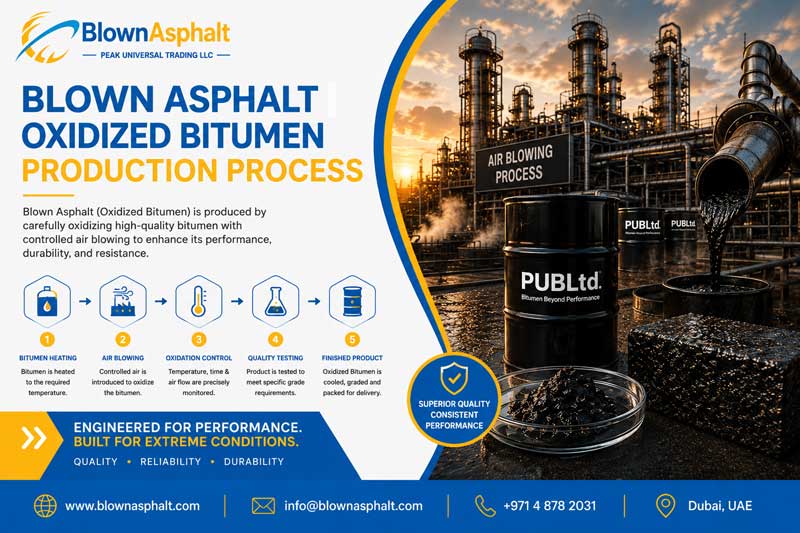
Production process of Oxidized Bitumen:

  1. Bitumen heating to 265-270 °C
  2. Transferring melted bitumen to blowing towers
  3. Blowing air to bitumen
  4. Cooling melted bitumen with water
  5. Packing

The procedures of producing bitumen are as follows:

  1. Continuous blowing procedure
  2. Discontinuous blowing procedure

These two procedures are done by other two procedures named catalysis and anti-catalysis.

Catalysis means adding some chemical material during the process In order to decrease blowing reaction time.

For the following reasons:

  • Ease and simplicity in changing blowing condition and have a production with different grades as a result.
  • Ease in generating the unit.
  • Ease in technology and also low expense in investment. The discontinuous producing procedure is chosen.

The production process is as follows:

The producing operation of oxidized bitumen mainly includes tank loading different steps, bitumen blowing, condenser external gasses and packing. So, in the beginning, the loose bitumen shipped to the plant by tanker is transferred to the raw material store tanker.

In order to transfer the bitumen easily to the blowing tower, the burner is contrived at the bottom of the store tanker to heat them. It is necessary to say that if the blowing towers are empty, hot bitumen can be uploaded directly to them and blowing operation start.

Since the volume of bitumen increases as a result of blowing and it may overflow, the blowing the tower is filled up to 70 %. Air injection is usually done when the temperature of material reach to 190-230 °C.

For gradual heating and also pipes filling with the air is entered from the top of the tower and at the bottom, the bitumen dispread monotonously in phase via nozzles then oxidation is done accordingly and the light molecule, volatile gasses, and steam are emitted from the top of the tower.

Blowing operation is done in the temperature range 215-290°C but the suitable temperature is between 265 to 270°C. The needed heat is provided by burner contrived at the bottom of the tower.

The bitumen reaction is calorific so in order to prevent the explosion danger resulted from temperature increasing, the temperature can be controlled by water injection, burner extinguisher and air amount reducing.The blowing end point is usually signified by sampling from tower and bitumen properties testing.

The blowing operation stops when blown asphalt reaches to specified properties. After this in order to fix the final point and depolymerization bitumen got in high temperature. It is necessary to be transferred to store after packing and presented to sale. It is necessary to say that the produced gas and steam entered the condenser through the pipe fixed at the top of the blowing tower.

In this stage, the bad smelling gasses and oily and volatile parts are separated from then transfer to sewage accompanied with water. Others separated gas parts are emitted from the top of the condenser then transfer to the furnace and burned there.

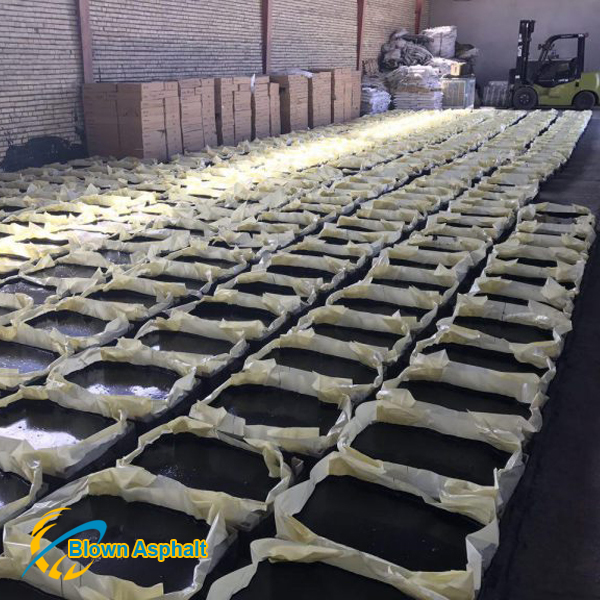
After cooling the blowing oven and reaching them to 150-160°C, all the content of blowing oven which is hard bitumen is able to be loaded and packed. Because of the liquid height in blowing tower, oxidized bitumen is transferred by specific gravity and there is no need to use the pump. Packing is done in two sections and in drum and 25kg carton.

For fast operation (preventing from cooling & hardening) in every section, several taps are fixed so that it can fill specific drum and carton with bitumen at the same time.

Applications of Bitumen 60/70, Penetration Asphalt, Blown Asphalt Production Process,

Blown Asphalt or Oxidized bitumen Production Process testing standard

  • Analysis of commercial bulk cargoes to ASTM, ISO, EN and similar specifications
  • Analysis of the basic performance characteristics such as:
  • Penetration numbers
  • Needle penetration
  • Cone penetration
  • Hardness
  • Ductility
  • Melting point
  • Density
  • Storage monitoring to assess oxidation state
  • Testing of drummed bitumen over time to assess’ batch lifetime.

Blown Asphalt or Oxidized Bitumen Production Process Standard Testing Table

NO
Reference and standard number
Specification of test
1EN 1426NEEDLE PENETRATION
2EN 1427SOFTENING POINT
3EN 12592SOLUBILITY
4EN 12593FRAASS BREAKING POINT
5EN 12595KINEMATIC VISCOSITY
6EN 12596DYNAMIC VISCOSITY BY VACUUM CAPILLARY
7EN 12607-1RESISTANCE TO HARDENING UNDER INFLUENCE OF HEAT AND AIR PART1: RTFOT
8EN 22592FLASH AND FIRE POINT- CLEVELAND OPEN CUP
9EN 12719FLASH POINT-PENSKY- MARTENS CLSED CUP
10EN ISO 3838DENSITY OR RELATIVE DENSITY –CAPILLARY PYKNOMETER
11EN 13301STAINING TENDENCY OF BITUMEN
12EN 13302VISCOSITY OF BITUMEN USING A ROTATING SPINDLE APPARATUS
13EN 13303LOSS IN MASS AFTER HEATING OF INDUSTRIAL BITUMEN
14EN 13398ELASTIC RECOVERY OF MODIFIED BITUMEN
15EN 13399STORAGE STABILITY OF MODIFIED BITUMEN
16EN 13587TENSILE PROPERTIES OF BITUMINOUS BINDERS BY THE TENSILE METHOD
17EN 13588COHESION OF BITUMINOUS BINDERS WITH PENDULUM TEST
18EN 13589TENSILE PROPERTIES OF MODIFIED BITUMEN BY THE FORCE DUCTILITY METHOD
19EN 13702-1MODIFIED BITUMEN PART1: CONE AND PLATE METHOD
20EN 13702-2MODIFIED BITUMEN PART2: COAXIAL CYLINDERS  METHOD
21EN 13703DEFORMATION ENERGY
22EN 58BITUMEN SAMPLING
23EN 12594PREPARATION OF TEST SAMPLES