What is Blown Asphalt?

The properties of asphalt can be modified by air blowing in batch and continuous processes. Blown asphalt or Oxidized bitumen has more and stronger molecular interactions than the original bitumen and is, therefore, more cohesive.

The properties of asphalt can be modified by air blowing in batch and continuous processes. Blown asphalt has more and stronger molecular interactions than the original bitumen and is, therefore, more cohesive. Blowing causes the softening point to increase and the penetration to decrease.

However, the increase in softening point is usually more than the decrease in penetration. This means that blowing reduces the temperature susceptibility of bitumen. The effectiveness of blowing depends largely on the original bitumen (i.e. the original mixture of molecular structures).

The regular distillation process is discontinued at some point while the topped crude is still liquid. The heavy fraction is then put into a converter and air is blown through it while it is maintained at a high temperature.

This process is continued until the asphalt has attained desired properties. Often, such asphalts are called Blown asphalt or Oxidized bitumen. However, this is not strictly a true term because not only oxidation but also vaporization, Dehydrogenation, condensation, polymerization and other reactions occur during the air blowing process.

Peak Universal Business is the ideal supplier for all your Blown Asphalt needs.

Applications of Bitumen 60/70

What is Blown asphalt?

Blown asphalt comes from hot air blown to pure bitumen in the last stage of refining. In this process, hot air having 200-300 degree centigrade temperature is blown to bitumen container with porous tubes.

In this process, hydrogen atoms in bitumen hydrocarbon are combined with oxygen in the air and by forming water, polymerization happens. Compared with pure bitumen, blown bitumen has a low penetration rate and a high softness point.

Blown asphalt grades or Oxidized bitumen are produced by passing air through the penetration grades. This process gives the bitumen more rubbery properties than its original formula and they are simply harder bitumen.

Hard bitumen under controlled temperature conditions is widely used as an anti-slip layer compound in the piling industry, for the manufacture of roofing felts, the roofing and waterproofing industries, for sound dampening, felts and under carriage sealant in the automotive industry, electric cable joint protection, joint filling compound, sealant compound and many others.

Also used in sealing saw cuts and joints where expected movements are minimum. It is also used in the manufacturing of bituminous marine mastic for the oil & gas pipeline joints.

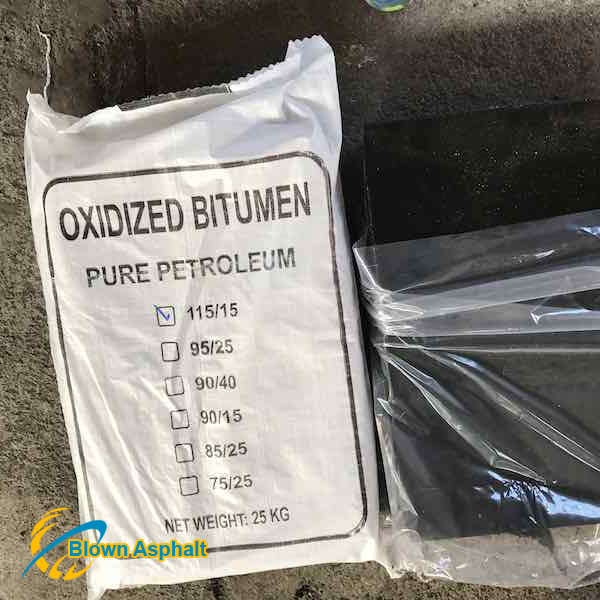
The most popular grades are; grades 95/2585/2590/40, 150/5 and 115/15. We are also capable of producing other grades of blown Bitumen upon request by our customers. Oxidized Bitumen high softening temperatures qualify them as an excellent sealant for prevention from bleeding in high-temperature applications. Blown Grade asphalt shall be broken up into small pieces (for the blown grade in molded cake form) and heated slowly to the application temperature of 220ºC to 230ºC.

Blown Bitumen is predominantly used in the piling industry as an anti-slip compound for the manufacture of undercarriage sealants in the automobile industry. It is also used as a sealant compound, as a joint filling compound apart from being used in the manufacture of roofing felts and sound dampening felts.

Further, Blown asphalt is used in the manufacture of bituminous marine mastic, which is required for the oil and gas pipeline joints. This blown asphalt is available in different grades like 95/25, 85/25, 75/25, 75/35, 90/40, 75/35 and 115/15.

Other grades of blown asphalt are produced according to the specifications of individual clients. Some of the major advantages of blown asphalt are that it is completely water resistant, highly flexible and durable. Further, it is chemically very stable.

Blown asphalt is a very flexible compound that is not only chemically stable but also a very durable compound apart from being completely water resistant. Lastly, blown asphalt has some very prominent technical advantages that make it a very sought after compound in various applications.

Applications of Bitumen 60/70, Penetration Asphalt

Uses and Application of Blown asphalt

  • As a bonding bitumen for roofing sheet membranes.
  • For rust proof pipe coatings.
  • As a hot-applied waterproofing layer.
  • As a raw material for liquid bitumen coatings.
  • Used as an anti-slip layer compound in the piling industry.
  • For the production of bituminous paints, mastic.
  • Used for production of roofing and sound dampening felts, Used as under carriage sealant in the automobile industry electric cable joint protection, joint filling compound, sealant compound and much more in our day to day life.
  • Oxidized Bitumen has a wide variety of industrial applications.

Properties of Bitumens used in roofing

Because bitumen is used in a number of roofing products and systems calling for different physical properties, both straight-run bitumens, and blown asphalt processed to a range of viscosities, are used in roofing. Historically, both straight run and oxidized bitumens have been manufactured by petroleum refineries, and this remains largely true in Europe today.

A separate description of the global bitumen manufacturing industry describes North American and European bitumen manufacturing processes, and the chemistry and physical properties of straight run and oxidized bitumens, from the refiner’s perspective.

In North America, most oxidized bitumen is produced downstream of refineries, by roofing product manufacturers and other bitumen processors who acquire straight-run bitumen from refineries for use as feedstocks for oxidation operations.

Chemistry of Air Blowing Oxidation, or air blowing, is the process of passing air through heated bitumen to raise the softening point/viscosity of the bitumen while maintaining much of its flexibility at lower temperatures. The use of this process dates from the late 19th century and it is used to make a wide variety of products with markedly different softening points depending on the extent of oxidation used.

On one end of this continuum are very slightly blown asphalt used for felt saturant and modified bitumen membranes, which are oxidized to softening points below 50°C, in the range of air rectified bitumens.

The hardest bitumens typically used in roofing products BUR products meeting North American specifications for Types III and IV, and shingle coatings are oxidized to softening points of roughly 100°C.These products, however, actually lie at an intermediate point on the continuum of bitumen oxidation.

At the upper end of the range are tired processing aids and drilling mud additives oxidized to softening points around 150°C. It is difficult to achieve softening points higher than this with commercial oxidation equipment operated at standard temperatures.