Weather Conditions Suitable for Bitumen 60/70
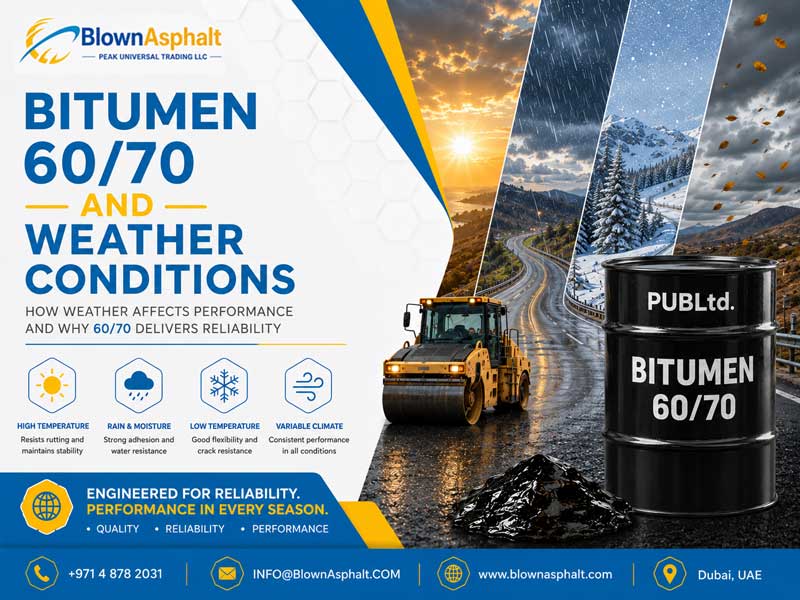
The performance of Bitumen 60/70 is highly dependent on environmental temperature and climatic conditions because it is a thermoplastic material whose viscosity changes with heat and cold. This means its stiffness, flexibility, and resistance to deformation are directly influenced by weather conditions throughout its service life. Selecting the correct climatic zone for this binder is essential to ensure pavement durability, structural stability, and long-term resistance to cracking or rutting.
Moderate Temperature Climates (Optimal Performance Range)
Bitumen 60/70 performs best in moderate climates where pavement temperatures typically remain within a balanced range throughout the year. In these conditions, the binder maintains an ideal balance between stiffness and flexibility, allowing asphalt layers to resist both deformation under traffic loads and cracking during cooler periods. This makes it suitable for highways, urban roads, and general infrastructure projects where environmental extremes are limited.
In such climates, the binder demonstrates stable long-term behavior with minimal performance loss, making it the standard choice for most conventional road construction projects.
Hot and Warm Climates (Rutting Resistance Zone)
In warm and hot regions, pavement surfaces are exposed to high solar radiation and elevated temperatures, which can significantly soften asphalt binders. Penetration Bitumen 60/70 is specifically designed to withstand moderate-to-high temperatures due to its relatively higher softening point compared to softer penetration grades.
In these environments, it provides adequate resistance against rutting and permanent deformation, especially in medium to heavy traffic roads. However, in extreme desert conditions where surface temperatures frequently exceed critical thresholds, performance may decline under heavy loads, and modified binders may be preferred.
Cold Climate Conditions (Cracking Sensitivity Zone)
In cold climates, Bitumen 60/70 becomes stiffer as temperatures drop, which increases the risk of thermal cracking and fatigue-related pavement distress. During winter conditions or freeze–thaw cycles, the reduced flexibility of the binder limits its ability to accommodate contraction in the asphalt layer.
For this reason, its use in very cold regions is generally limited, and softer penetration grades or performance-graded binders are often recommended for better low-temperature flexibility.
Humid and Rainy Environments (Moisture Interaction Zone)
Humidity and rainfall do not directly alter the physical hardness of Bitumen 60/70, but they significantly influence adhesion between bitumen and aggregates. In wet conditions, poor drainage or inadequate mix design can lead to moisture penetration, stripping, and loss of bond strength within the pavement structure.
When properly designed with suitable aggregates and anti-stripping additives, Bitumen 60/70 can perform well in humid and rainy climates, maintaining structural integrity under moisture exposure.
Key Engineering Insight
The overall performance of Bitumen 60/70 is not defined by a single climate type but by the interaction between temperature, moisture, and traffic load. Its optimal application lies in regions with moderate to warm climates, while extreme cold or extreme heat conditions require additional engineering modifications to ensure long-term pavement performance.



Leave a Reply
Want to join the discussion?Feel free to contribute!