How to Produce Oxidized Bitumen

Oxidized bitumen, also called ” Blown Bitumen” or “Blown Asphalt ” is produced by blowing hot air through a base bitumen (penetration grade) at elevated temperatures, which causes a chemical reaction that makes the bitumen harder and more viscous by essentially “oxidizing” it; this process involves heating the bitumen to a specific temperature and then continuously injecting air into it under controlled conditions to achieve the desired properties

Production Process of Blown Asphalt

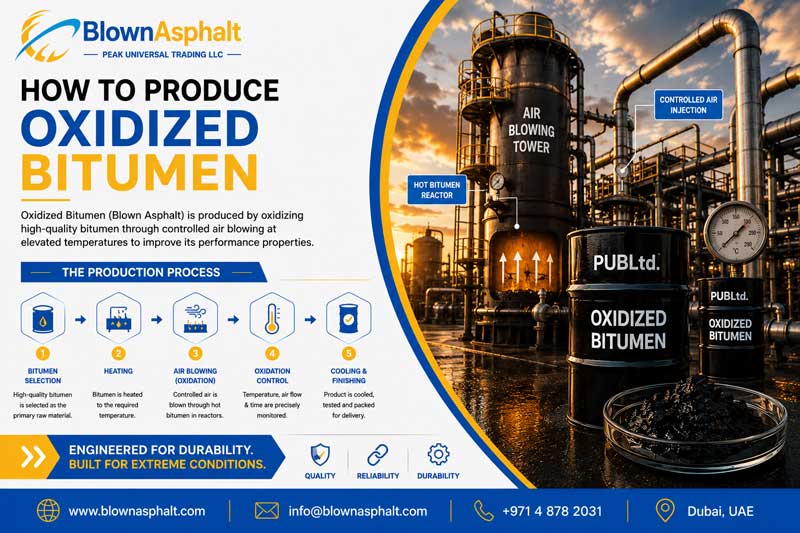
1. Bitumen heating to 265-270 °C
2. Transferring melted bitumen to blowing towers
3. Blowing air to bitumen
4. Cooling melted bitumen with water
5. Packing

The procedures for producing oxidized bitumen are as follows:

  • Continuous blowing procedure
  • Discontinuous blowing procedure These two procedures are done by the other two procedures named catalysis and anticatalysis.

Catalysis means adding some chemical material during the process In order to decrease the blowing reaction time. For the following reasons:

  • Ease and simplicity in changing blowing condition and have the product with different grades as a result.
  • Ease in generating the unit.
  • Ease in technology and also low expense in investment. The discontinuous producing procedure is chosen.

Technical point and operating conditions of oxidized bitumen are as follows:

  • The blowing should be done from the bottom of blowing tanker. The reaction between bitumen and air is calorific. If the heat produced during the mixture is high, the heat of reaction is controlled by water injection.
  • Admixture of air and the volume of blowing air is two important variants in the blowing process. In bitumen producing the plant, bitumen 60/70 is usually got by blowing. In this case for making bitumen 90/15 or 85/25 distilled used oil or crude oil should be injected to the product according to the volume 20-25 % otherwise the fragility in bitumen lead to inferior production.
  • Increasing the heating temperature, air injection amount, time and tower pressure increase the speed of production process reaction.
  • Oxidized Bitumen Production Process

  • Manufacturing Oxidized Bitumen Guide

  • Steps to Produce Oxidized Bitumen

  • Oxidized Bitumen Making Techniques

  • Industrial Oxidized Bitumen Production

Applications of Bitumen 60/70, Blown Asphalt Production Process,

Production process of Oxidized Bitumen:

  1. Bitumen heating to 265-270 °C
  2. Transferring melted bitumen to blowing towers
  3. Blowing air to bitumen
  4. Cooling melted bitumen with water
  5. Packing

The procedures of producing bitumen are as follows:

  1. Continuous blowing procedure
  2. Discontinuous blowing procedure

These two procedures are done by other two procedures named catalysis and anti-catalysis.

Catalysis means adding some chemical material during the process In order to decrease blowing reaction time.

For the following reasons:

  • Ease and simplicity in changing blowing condition and have a production with different grades as a result.
  • Ease in generating the unit.
  • Ease in technology and also low expense in investment. The discontinuous producing procedure is chosen.

The production process is as follows:

The producing operation of oxidized bitumen mainly includes tank loading different steps, bitumen blowing, condenser external gasses and packing. So, in the beginning, the loose bitumen shipped to the plant by tanker is transferred to the raw material store tanker.

In order to transfer the bitumen easily to the blowing tower, the burner is contrived at the bottom of the store tanker to heat them. It is necessary to say that if the blowing towers are empty, hot bitumen can be uploaded directly to them and blowing operation start.

Since the volume of bitumen increases as a result of blowing and it may overflow, the blowing the tower is filled up to 70 %. Air injection is usually done when the temperature of material reach to 190-230 °C.

For gradual heating and also pipes filling with the air is entered from the top of the tower and at the bottom, the bitumen dispread monotonously in phase via nozzles then oxidation is done accordingly and the light molecule, volatile gasses, and steam are emitted from the top of the tower.

Blowing operation is done in the temperature range 215-290°C but the suitable temperature is between 265 to 270°C. The needed heat is provided by burner contrived at the bottom of the tower.

The bitumen reaction is calorific so in order to prevent the explosion danger resulted from temperature increasing, the temperature can be controlled by water injection, burner extinguisher and air amount reducing.The blowing end point is usually signified by sampling from tower and bitumen properties testing.

The blowing operation stops when blown asphalt reaches to specified properties. After this in order to fix the final point and depolymerization bitumen got in high temperature. It is necessary to be transferred to store after packing and presented to sale. It is necessary to say that the produced gas and steam entered the condenser through the pipe fixed at the top of the blowing tower.

In this stage, the bad smelling gasses and oily and volatile parts are separated from then transfer to sewage accompanied with water. Others separated gas parts are emitted from the top of the condenser then transfer to the furnace and burned there.

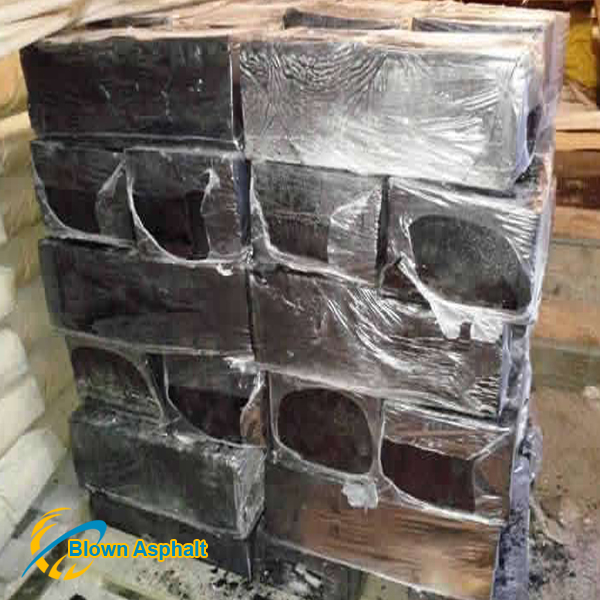
After cooling the blowing oven and reaching them to 150-160°C, all the content of blowing oven which is hard bitumen is able to be loaded and packed. Because of the liquid height in blowing tower, oxidized bitumen is transferred by specific gravity and there is no need to use the pump. Packing is done in two sections and in drum and 25kg carton.

For fast operation (preventing from cooling & hardening) in every section, several taps are fixed so that it can fill specific drum and carton with bitumen at the same time.

Applications of Bitumen 60/70, Penetration Asphalt, Blown Asphalt Production Process, How to Produce Oxidized Bitumen?

Air Blown Oxidized Bitumen

  • The suitable temperature for production operation is 265-270°C which should be controlled not to be ascended since in high temperature and in 288°C intensity of reaction becomes more sever and incontrollable which lead to the explosion in the tower.
  • ¨ The longtime stay of bitumen in the tower in any condition is not in favor of system and should be delivered to drum or empty tanker after being ready.
  • ¨ If the liquid surface in blowing tower is low, not more than particular limit should be added to the system for the extra air gather in empty parts and lead to ignition nearly. And if the temperature is kept high, the inside heat of tower ascend fats and this issue cause inside explosion and endamage the system.
  • ¨ Blowing tower is filled up to 70%. Air injection is done at 190-232°C. The final point of blowing is specified by sampling and testing of bitumen properties. Finally, the temperature of the product should be kept 150- 165 °C in order to have loading and packing capability.

The Production Process of Oxidized Bitumen is as follows:

The producing operation of oxidized bitumen mainly includes tank loading different steps, bitumen blowing, condenser external gases and packing. So, in the beginning, the loose bitumen shipped to the plant by tanker is transferred to the raw material store tanker.

In order to transfer the bitumen easily to the blowing tower, the burner is contrived at the bottom of the store tanker to heat them. It is necessary to say that if the blowing towers are empty, hot bitumen can be uploaded directly to them and blowing operation start.

Since the volume of bitumen increases as a result of blowing and it may overflow, the blowing tower is filled up to 70 %. Air injection is usually done when the temperature of material reach to 190-230 °C.

For gradual heating and also pipes filling with the air is entered from the top of the tower and at the bottom, the bitumen dispread monotonously in phase via nozzle then oxidation is done accordingly and the light molecule, volatile gases, and steam are emitted from the top of the tower.

Bitumen Blowing operation

Blowing operation is done in the temperature range of 215-290°C but the suitable temperature is between 265 to 270°C. The needed heat is provided by burner contrived at the bottom of the tower.

The bitumen reaction is calorific so in order to prevent the explosion danger resulted from temperature increases, the temperature can be controlled by water injection, burner extinguisher and air amount reducing.

Blowing end-point is usually signified by sampling from tower and bitumen properties testing.

The blowing bitumen operation stops when oxidized bitumen reaches to specified properties. After this in order to fix the final point and depolymerization bitumen got in high temperature.

It is necessary to be transferred to the store after packing and presented for sale. It is necessary to say that the produced gas and steam entered the condenser through the pipe fixed at the top of the blowing tower. In this stage, the bad smelling gases and oily and volatile parts are separated from then transfer to sewage accompanied with water.

Other unseparated gas parts are emitted from the top of the condenser then transfer to the furnace and burned there. After cooling the blowing oven and reaching them to 150-160°C, all the content of blowing oven which is hard bitumen is able to be loaded and packed. Because of the liquid height in the blowing tower, oxidized bitumen is transferred by specific gravity and there is no need to use the pump.

Packing is done in two sections and in 220-liter drum and 35 kg carton. For fast operation (preventing from cooling & hardening) in every section, several taps are fixed so that it can fill specific drum and carton with bitumen at the same time.
  • Oxidized Bitumen Production Process
  • Manufacturing Oxidized Bitumen Guide
  • Steps to Produce Oxidized Bitumen
  • Oxidized Bitumen Making Techniques
  • Industrial Oxidized Bitumen Production

Blown Asphalt 105/35

Blown Asphalt 85/25

About us

PUBLtd